 Emily’s Blog
- Sunset Beach Tai Chi July 22, 2024
- Coffee with Abu… July 22, 2024
- Rumi Latte in Beverly Hills July 22, 2024
- Judging a Burmese TedTalk July 22, 2024
- Mystical Tajik Cafe in Beverly Hills July 21, 2024
- Hollywood: Brown Film Festival July 21, 2024
- New Play Premiere in Burma July 21, 2024
- Bhutan Meets Malibu & Mulholland July 21, 2024
- Tricycle Bliss July 21, 2024
- Kung Fu Panda July 21, 2024
Category Archives: Blog
Congrats, Jessika…
I am so grateful and delighted to accept the James W. Ray Distinguished Artist Award. It is a joy and humbling honor, which will truly support my life’s work, and I hope in turn will benefit my extended community in many ways. I hope that the spirit of projects and awards like these will help improve the atmosphere of our world, and lead to all kinds of generosity, understanding and diverse imaginings.
In a previous post on Sufism and Buddhism, I shared a video of my friend Jessika Kenney singing verses from the Persian poetry of Rumi–in the presence of the Dalai Lama. Last week, for her exceptional talent and originality, Jessika received the inaugural $50,000 James W. Ray Distinguished Artist Award–the largest cash grant available to Washington State artists.
Having performed with Jessika in concert at Lincoln Center, Asia Society, and the Indonesian Consulate, I must say–not just as a friend and fan, but as a fellow musician–that she’s as good as it gets. A vocalist and composer charting new territory in experimental, metal, electronic, and improvised music, Jessika’s music is strongly influenced by her impressive command of traditional Persian and Javanese music. She has collaborated with Ostad Hossein Omoumi and Eyvind Kang, and performed around the world with groups like Orchestra del Teatro Communale and Coro da Camera di Modena (Italy), Gamelan Pacifica (Seattle), and Gamelan Madusari (Vancouver, BC).
I could go on and on about Jessika and her brilliance–but I’ll let her music speak for itself. As you can hear, her voice is from the heavens–and so is her heart…
Posted in Blog
Comments Off on Congrats, Jessika…
Hip-Hop in Java…
Gamelan + shadow puppets + Javanese poetry + hip hop = Jogja Hip Hop…
Posted in Blog
Comments Off on Hip-Hop in Java…
Gamelan in Beirut…
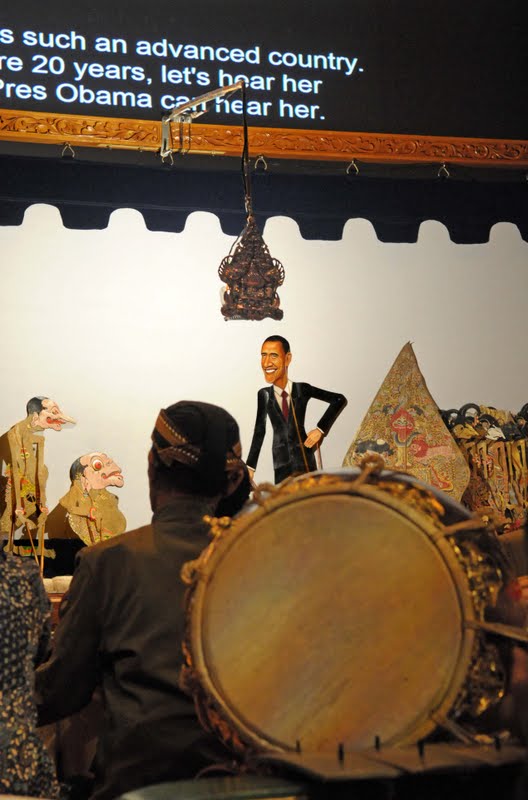
Obama puppet with the 'tree of life'
Living in Lebanon, I’ve been missing playing Javanese gamelan with my friends back home–but I’m comforted to know that gamelan music has been played in Beirut before. In the video above, a Lebanese cedar tree seems to float over a gamelan performance in Beirut like the “Tree of Life,”–a central “puppet” used in Javanese shadow puppet plays.
In the photo to the left, and in this video from our gamelan performance at Asia Society, you can see an Obama “puppet” standing next to a “tree of life.” Decorated on both sides, the “tree of life” has an aesthetic power that is not fully appreciated if it’s viewed only its shadow form.
Though the “tree of life” generally represents life and the cosmos, it holds a number of symbolic meanings and functions throughout a shadow puppet play. For example, it helps to demarcate time and space–by announcing scene changes, and representing various landscapes–like mountains and lakes.
Hopefully, one day soon, the gamelan will return to Beirut–and bring with it a “tree of life”–to greet the Cedars of Lebanon…
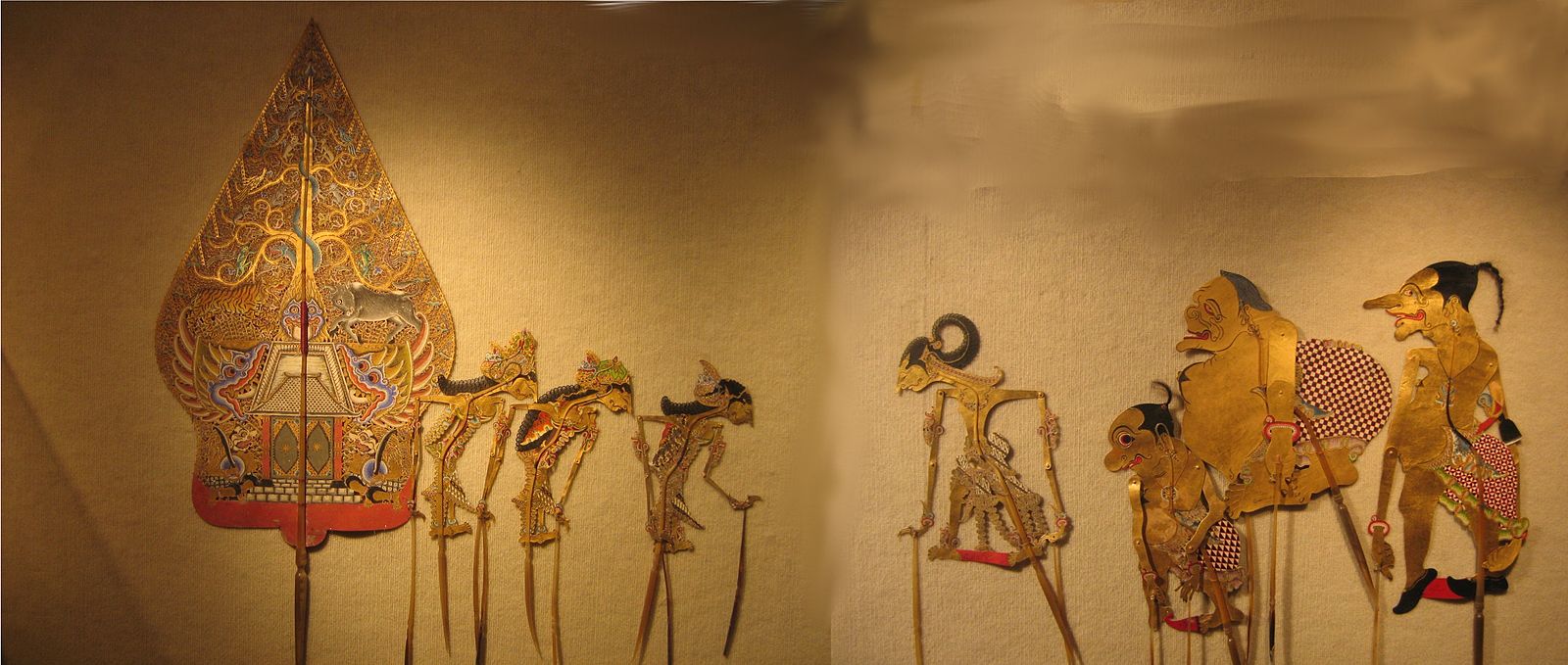
Shadow puppets from central Java (University of Hawaii Dept. of Theater and Dance)
.
Posted in Blog
Comments Off on Gamelan in Beirut…
On Time….
As my students and I contemplate “time” this week in the writings of Augustine, I’ve been re-visiting the connections between Augustine and Beckett on the notion of time, the origin of creative activity, and the relationship between memory and the narrative imperative. In a conversation earlier today with John Emigh about “time” in Beckett’s “Waiting for Godot,” he reminded me of the passage below by John Donne:
What poor elements are our happinesses made of, if time, time which we can scarce consider to be any thing, be an essential part of our happiness! All things are done in some place; but if we consider place to be no more but the next hollow superficies of the air, alas! how thin and fluid a thing is air, and how thin a film is a superficies, and a superficies of air! All things are done in time too, but if we consider time to be but the measure of motion, and howsoever it may seem to have three stations, past, present, and future, yet the first and last of these are not (one is not now, and the other is not yet), and that which you call present, is not now the same that it was when you began to call it so in this line (before you sound that word present, or that monosyllable now, the present and the now is past). If this imaginary, half-nothing time, be of the essence of our happinesses, how can they be thought durable? Time is not so; how can they be thought to be? Time is not so; not so considered in any of the parts thereof…
Posted in Blog
Comments Off on On Time….
Zarif in Denver…
Today, Dr. Mohammad Javad Zarif (محمد جواد ظریف خوانساری), the Minister of Foreign Affairs for the Islamic Republic of Iran, will be speaking via video conference at the University of Denver. The conversation, which will be streamed live at this link at 2 pm EST, will be moderated by Ambassador Christopher R. Hill, Dean of the Josef Korbel School of International Studies. The setting for today’s talk makes sense–since Dr. Zarif received his second MA and PhD at the University of Denver. In fact, Iran’s government has more cabinet members with Ph.D. degrees from U.S. universities than the U.S government does. Iran also has more American Ph.D.s in its presidential cabinet than Germany, France, Japan, Italy, Spain or Russia—combined.
Here’s a blurb from the University of Denver’s press release about this “momentous event in US and Iranian diplomatic history”:
Dr. Mohammad Javad Zarif is the Minister of Foreign Affairs for the Islamic Republic of Iran. Prior to assuming that post in August 2013, Dr. Zarif served as Iran’s Ambassador to the United Nations (2002-2007) and Iran’s Deputy Minister of Foreign Affairs (1992-2002). In addition to his distinguished diplomatic career, Dr. Zarif is also a proud University of Denver alumnus, earning both his MA and PhD in International Studies from DU’s Graduate School of International Studies (now the Josef Korbel School) in 1984 and 1988, respectively. Dr. Zarif will discuss the current contours of US-Iranian relations with Dean Hill via video conference from Vienna, Austria, where he is working with Secretary of State John Kerry on finalizing a deal regarding Iran’s nuclear program.
Posted in Blog
Comments Off on Zarif in Denver…
Sudanese TV…
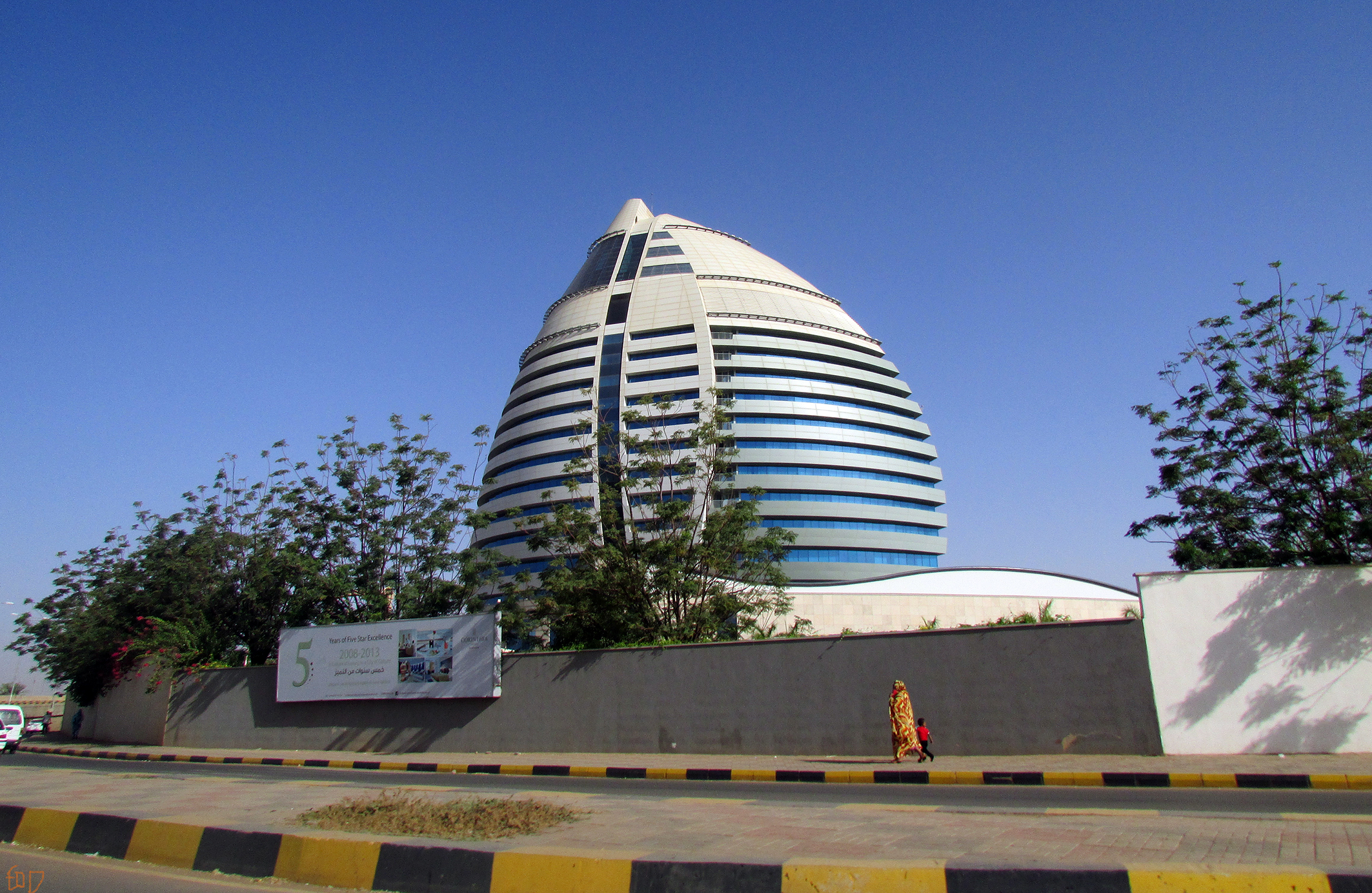
Exploring Khartoum (Photo: Emily O'Dell)
Posted in Blog
Comments Off on Sudanese TV…
Mondial 2010…
For his film Mondial 2010, Lebanese director and art critic Roy Dib was awarded the Teddy Award for best short film at the 64th Berlin International Film Festival. In music and film, Lebanese artists have had a strong showing this week at awards ceremonies throughout Europe.
Here’s a synopsis of his award-winning film: Mondial 2010 is a film on love and place. A Lebanese gay couple decides to take a road trip to Ramallah. The film is recorded with their camera as they chronicle their journey. The protagonists and the viewers are invited through the couple’s conversations into the universe of a fading city.
Posted in Blog
Comments Off on Mondial 2010…
Sufism in Baku & Beyond (نجمالدین رازی)…
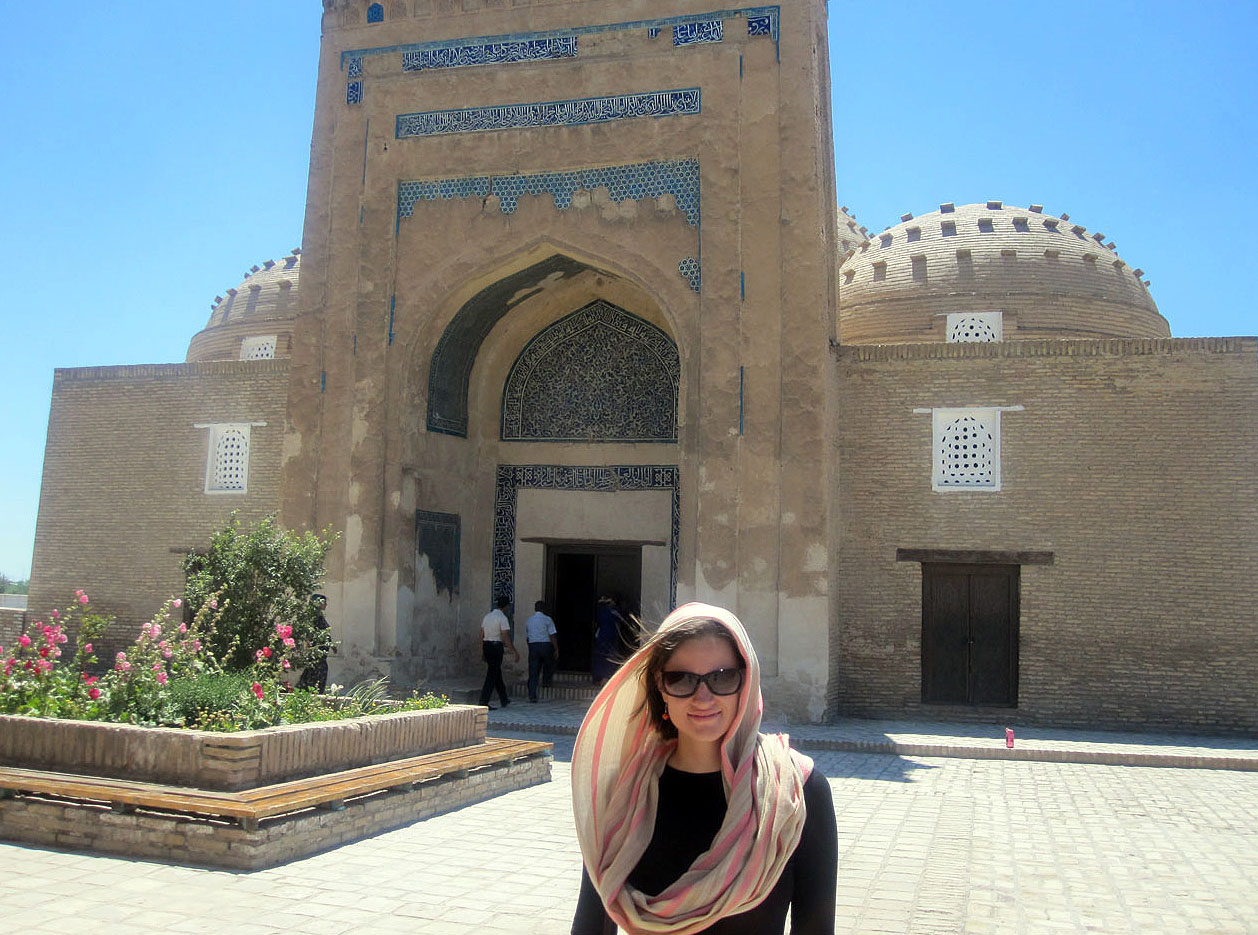
The shrine of Najm al-Din Kubra in Turkmenistan (Photo: Emily O
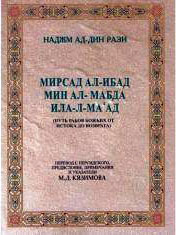 Since I tend to spend my time researching and publishing on Iran, Russia, and Sufism (among other things), I was excited to see that a Russian translation of “Mirsad al-Ibad” (مرصاد العباد من المبدا الی المعاد), written by the 13th century Persian mystic Najm ad-Din Razi, was just published in Baku, Azerbaijan. This medieval Persian masterpiece, which surveys the philosophical dimensions and spiritual practices of Sufism, is available in English under the title “The Path of God’s Bondsmen: From Origin to Return.”
Each moment I tire anew of my being,
And long anew for union with that beauty.
When the moth of my heart sees the candle of your face,
It disdains both worlds in its madness…
— Najm al-Din Razi
Najm ad-Din Razi belonged to the Kubrawiyya Sufi Order–named after the Sufi sheikh Najm al-Din Kubra (d. 1220). When I was in Turkmenistan doing research on Sufism, I was fortunate to spend time at the shrine of Najm al-Din Kubra–where many Turkmen still go today to pray and ask for a blessing…
Posted in Blog
Comments Off on Sufism in Baku & Beyond (نجمالدین رازی)…
From Hell, With Love…
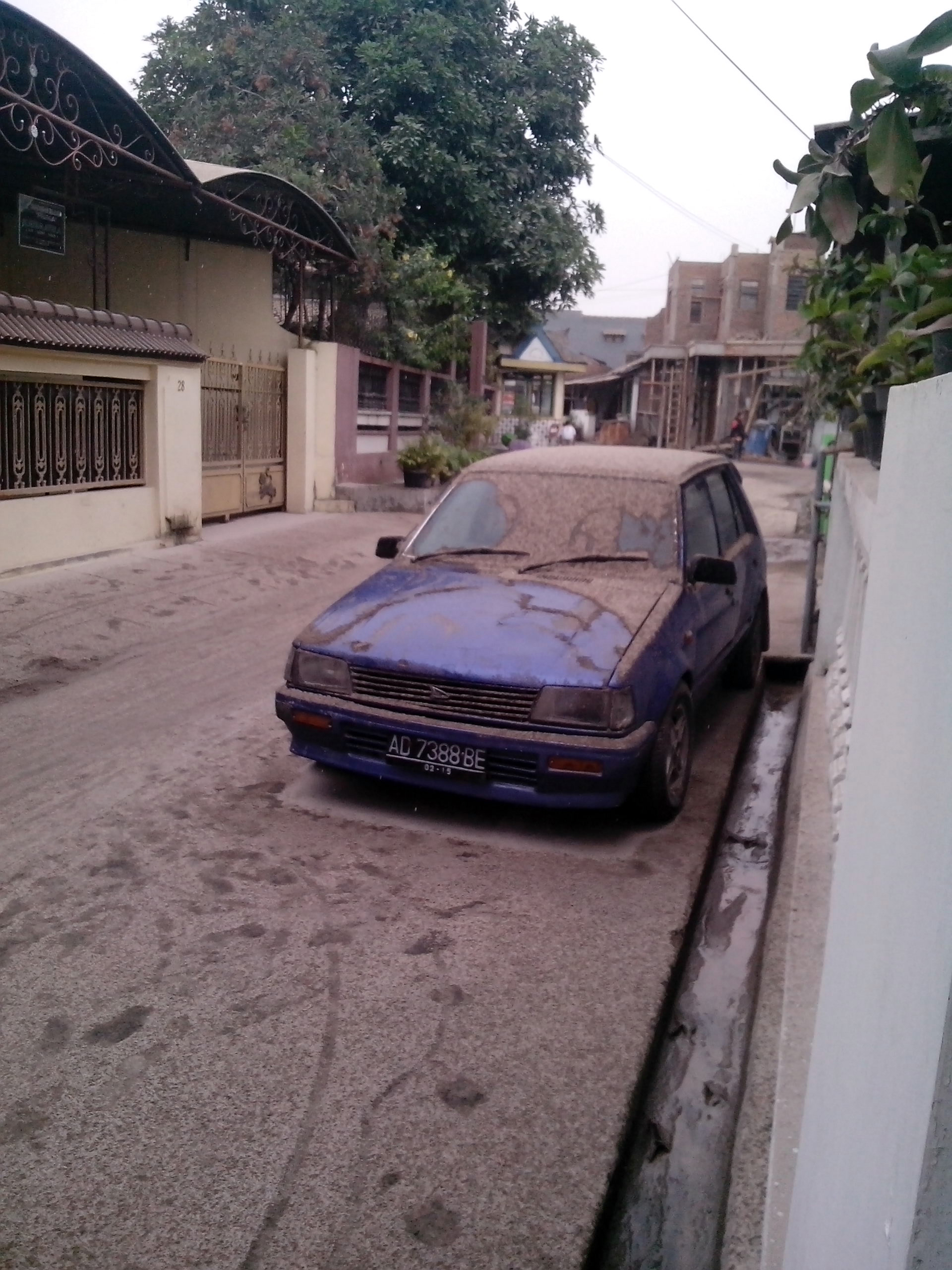
Today in Java (Photo: Jon Rea)
In the piece below, my friend Jon Rea shares a first-hand account of the fall-out from the deadly volcanic eruption of Mt. Kelud in Indonesia–where Javanese cities like Solo, Yogyakarta, Malang, and Surabaya have been showered with volcanic ash. Over the week-end, 100,000 people were evacuated, and several airports were closed.

Writing in ash (Photo: Rini Driatmeka)
From Hell, With Love
Jon Rea
February 17th 2014
Solo, Indonesia
This Valentine’s Day in New York, pure white snow was falling from heaven. On the other side of the world, however, Indonesia got a Valentine’s missive from below. Gunung Kelud committed suicide; its death wish was the spreading of its ashes as far as 600 kilometers away. Three days later, Java’s 140 million citizens, and millions more in Sumatra, are still struggling to cope with the disaster, and the ash cloud is still spreading.
It started with a big, low rumble on Thursday night that we thought was our neighbor playing his annoying dangdut music too loudly, as usual. But when other friends across the city mentioned that they had also heard the noise, we realized that it was no dangdut party. Some 200 kilometers to the east of Solo, Gunung (Mount) Kelud, one of Indonesia’s most violent and destructive volcanoes, had erupted for the first time since 2007.
Living in the most active volcano region in the world, with Gunung Merapi and Gunung Merbabu on our western horizon, and Gunung Lawu in the East on clear days, we went to bed and didn’t think much more about it. We woke up on Valentine’s Day to a bizarre snow-grey-white ash falling from the sky, blanketing the cars and roads, trees and crops and roofs beneath.
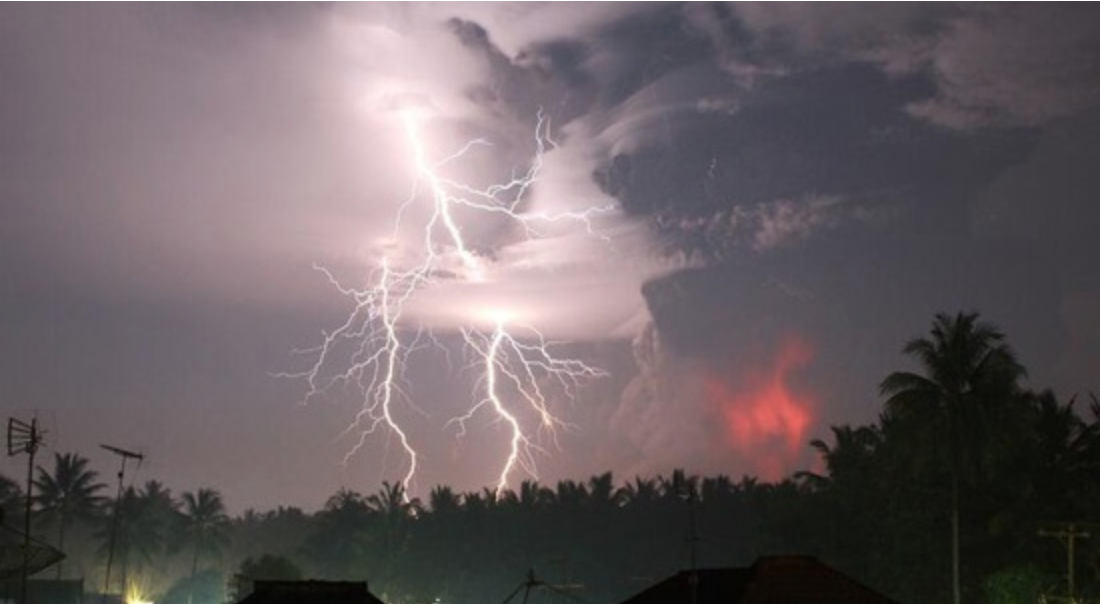
Mt. Kelud Eruption on February 14th (@hilmi_dzi)
Indonesian houses are built to be open to the generally benign tropical weather, and the ash was coming straight inside through the permanently open windows. It was sticking to sheets and pillows, clothes and furniture, dishes, TVs, and this writer is still wiping it out of his computer as he types, 3 days later. The internet was down. Only one TV station seemed up-to-date on the occurring disaster, and they had naturally put their focus closer to the sight of the eruption. My wife and I didn’t know what to do.
We tried to stay inside, but every second there was more and more dust coming in. We worried about our family, and decided to drive over to their house, 5 kilometers away. We put on face masks, closed our helmet visors, and drove our motorbike out through the wasteland, which looked exactly like a swirling snow flurry. It wasn’t until 2 days later, when the internet was up again, that we found out what a dangerous thing we had done.
Nobody was aware that the ash was so dangerous. The news channels said to stay inside and wear masks, but less than 12 hours after the eruption, almost every roadside store was sold out of masks, and you still had to drive to the store to look for your mask in the first place. We read about the danger of the ash, finally, on a friend’s Facebook page 2 days later. Its extra-fine size and jagged silicon structure make it extremely dangerous to inhale and damaging to the eyes.
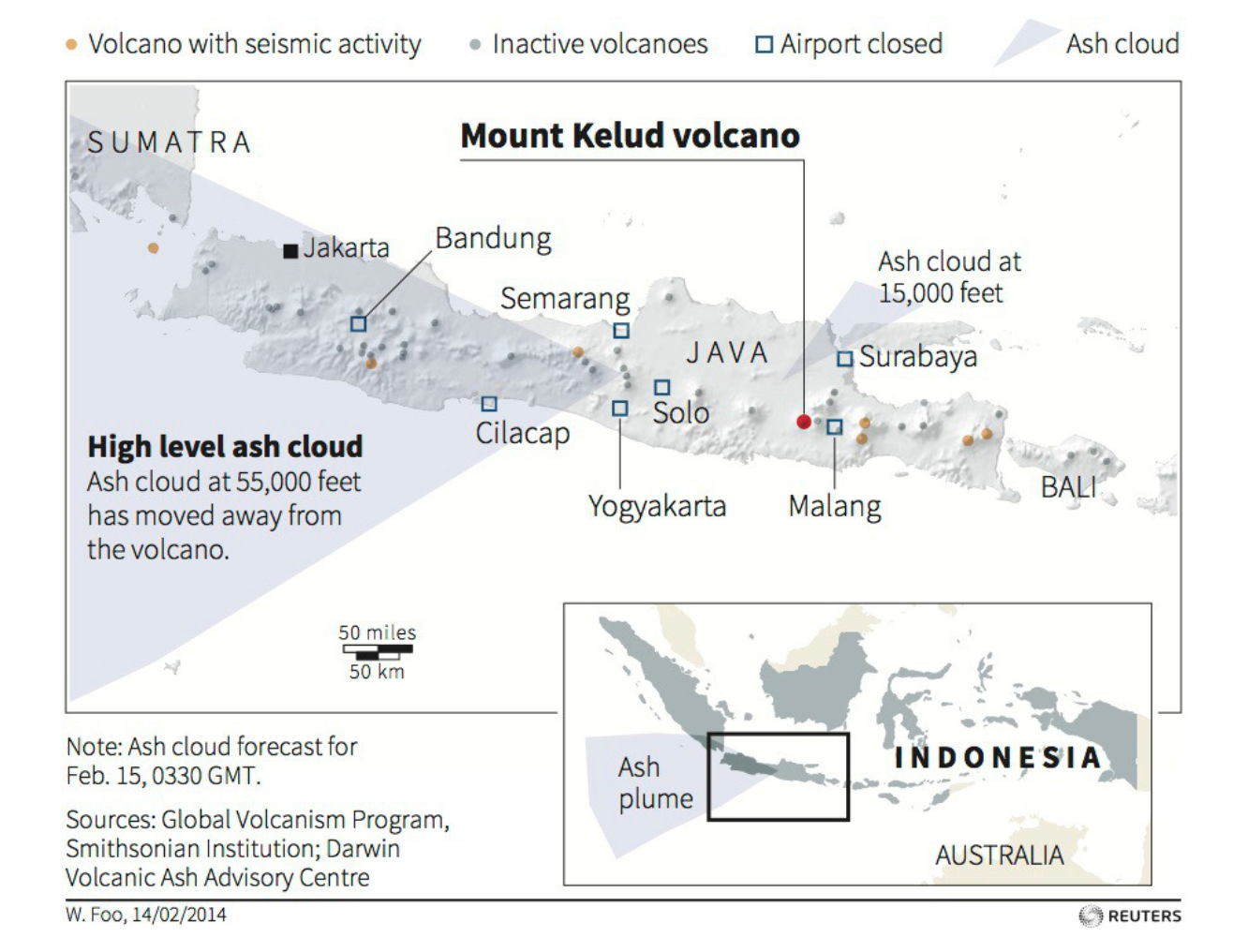
Mapping the damage...
No one had any information about what to do for the first 2 days. We never saw any police or any other government workers, we were on our own. People were outside their houses, holding their shirts over their noses, trying in vain to sweep away the ash. They were inside their houses, beating the dust off of clothes and back into the air where they could breathe it. They were riding on bicycles and motorbikes with no protection, stirring up the dust on the road. For two long, dry days, the citizens of Central Java lived and breathed the remains of Gunung Kelud.
News sources were speaking of only three victims of the eruption, but the number of deaths from breathing complications will never be counted or compiled. Personally, I know three such cases myself, from the last three days.
One victim was my friend, an expert Gamelan musician with a long history of lung problems. Another was a neighbor who passed away from a heart attack, the third a distant Aunt who died of unknown causes. No one can say how much of this could have been prevented, given the proper level of support and information.
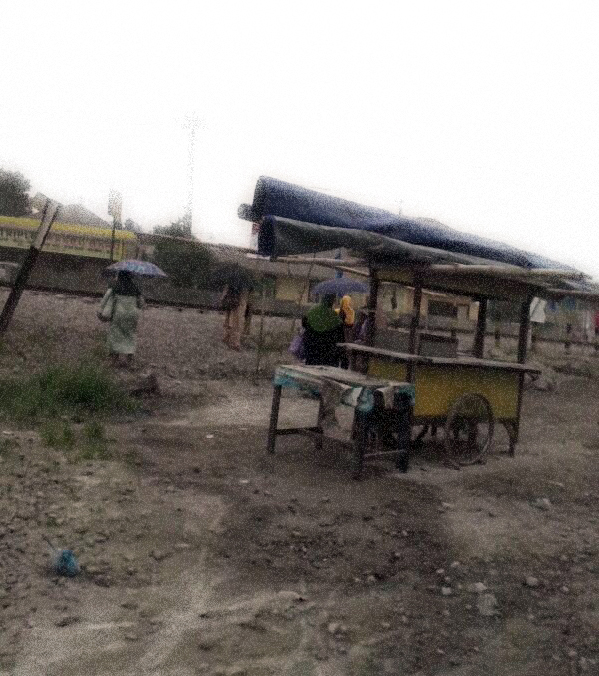
Ash & rain in Solo (Photo: Jon Rea)
The silver lining to this ash cloud came on Sunday, when the rain came. The wind came first, bringing more ash into the air and into the house, and into our eyes. But then the rain came, and we finally got our Valentine’s chocolate–it came cascading in waterfalls down from the roof and collected in lakes and rivers in the yards and roads, where it stuck, and as I type, still sits.
The thick mud acts like concrete, sticking to the surface of the road and the top of the soil, refusing to be washed away. It’s clogging drains now, just sitting there and waiting to get dry again.
We’re trying to shovel it up and put it out of sight, trying to sweep it out of our houses and wash it off our clothes. We’re going back to school and work on Monday. So ineffectual, but we have to try. This is a battle of nature now–let’s hope the rain wins.
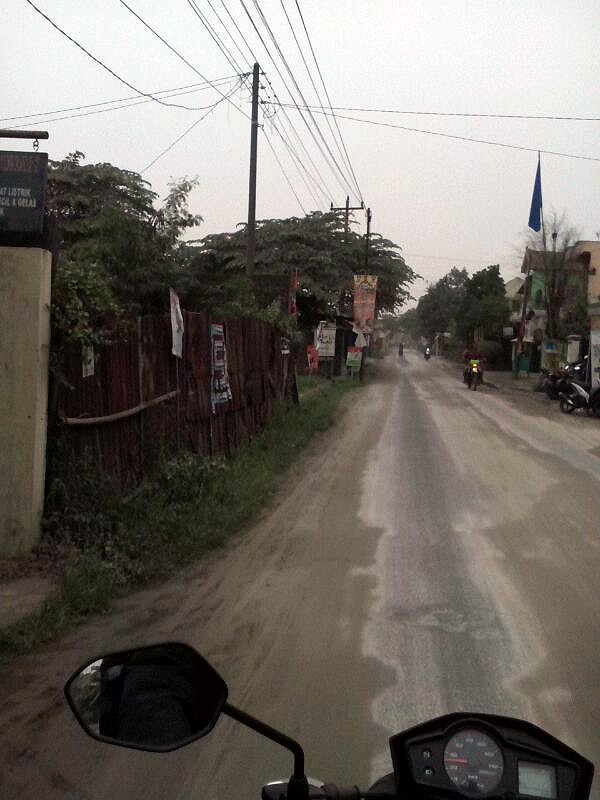
Cruising the streets of Solo (Photo: Jon Rea)
Posted in Blog
Comments Off on From Hell, With Love…
Finding (a) Home…(西南民族大学)

u
In November, robed monks from the Dongkar Monastery in western Sichuan arrived with a yellowing collection of 300-year-old texts that had never been published. Scrawled in cinnabar and black ink, the manuscripts, detailing the tantric rituals of Buddhist deities, were copies of 15th-century texts. The monks stayed for five weeks while archivists scanned 6,000 pages, then returned home carrying their beloved texts and a single CD-ROM of digital copies. They vowed to return with seven more volumes.
Posted in Blog
Comments Off on Finding (a) Home…(西南民族大学)
Professor of Archaeology…
In the wake of Sid Caesar’s death last week, his comedic sketches are being revisited. Here’s one of his skits from the mid-1950s, called “Professor of Archaeology.”
Posted in Blog
Comments Off on Professor of Archaeology…
Today in Beirut…

Today at St. Jude/CCCL (Photo: Emily O'Dell)
Posted in Blog
Comments Off on Today in Beirut…
Difret…
This week-end, the film Difret, produced by Angelina Jolie, won the prize for best fiction film screening in the Panorama section of the Berlin International Film Festival. This debut feature from Ethiopian filmmaker Zeresenay Berhane Mehari also won the World Cinema Dramatic Audience Award at the 2014 Sundance Film Festival. Though the plot of this Ethiopian film focuses on the bride abduction of a 14-year-old girl, bride kidnapping is not unique to Ethiopia. For example, in Central Asia, the old custom of bride kidnapping was recently revived in Kazakhstan and Kyrgyzstan (as you can see in the video below)…
Posted in Blog
Comments Off on Difret…
The Grand Budapest Hotel…
This week-end, Wes Anderson’s new film, The Grand Budapest Hotel, was awarded the Silver Bear Grand Jury Prize at the Berlin International Film Festival. The film, an inheritance dramedy which takes place in the 1920s, has too many well-known performers to name…
Posted in Blog
Comments Off on The Grand Budapest Hotel…